Local Guide
The Sleeping Bear Dunes Day Loop
A national park forty minutes from our door, and most of the good part fits in one day. This is the loop we drive with guests: bluff-top views, the wall of sand, the old company town, and a story the land has been telling far longer than we have.
The Most Beautiful Place in America, Allegedly
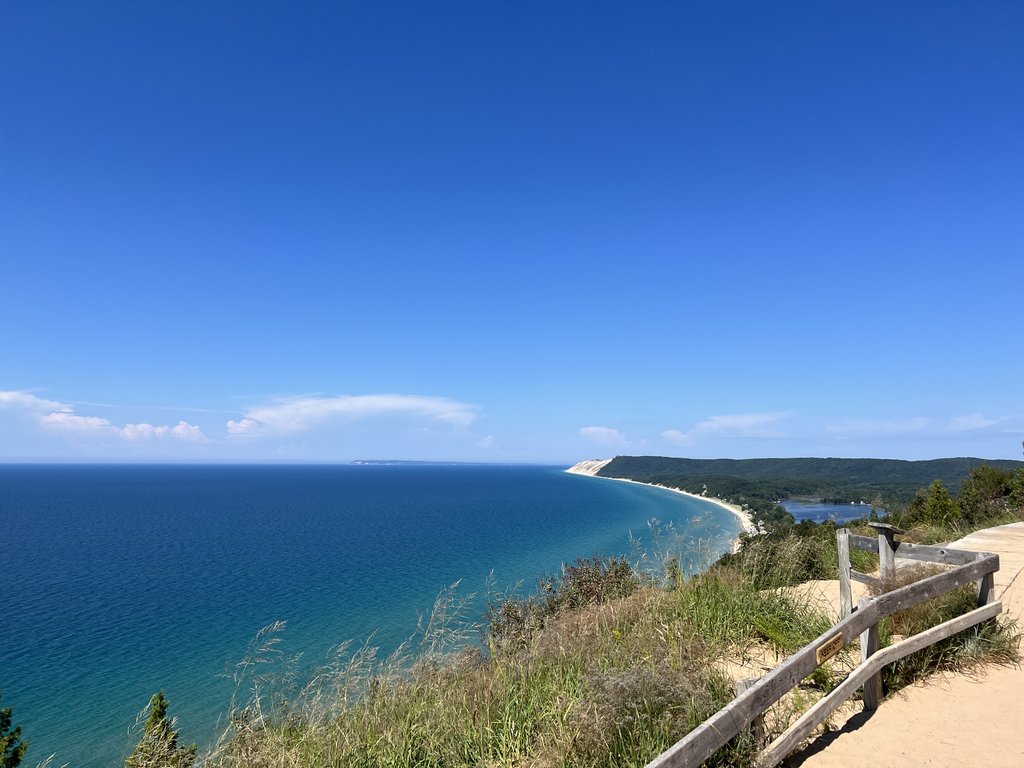
In 2011 the viewers of Good Morning America voted Sleeping Bear the most beautiful place in America, edging out Asheville. Those polls are noise, a way to sell a morning segment, and I would tell you to ignore it. Then you stand on the boardwalk at the end of the Empire Bluff trail, four hundred feet of sand dropping straight to water the color of a swimming pool, an island floating on the horizon, and the argument goes quiet. The scale does not come through a phone screen. You have to be up there.
What the name hides is that these are not beach dunes. The signature dunes here are perched dunes, sand sitting on top of a high plateau of gravel and rock that a glacier bulldozed into place and abandoned about twelve thousand years ago. That is why the sand starts hundreds of feet above the lake instead of at the waterline. The lakeshore runs thirty-five miles up the coast, folds in a couple of dozen inland lakes, and looks out at the Manitou Islands, and the National Park Service has kept the whole of it undeveloped since 1970.
The useful part for you is the geography. The park sits due west of Traverse City, a straight run out M-72, and the best of it lines up along one stretch of shore. You can hit the headline views, the famous climb, and a historic village between breakfast and dinner and still be back in your own kitchen at the Commons that night. Here is the order we drive it.
How a day actually runs
Our pacing for the full loop with two real hikes and a late lunch. Times assume an 8:30 am start and a summer sunset.
- 8:30 am Coffee, then out M-72 west
- 9:15 am Empire Bluff, the first view before the crowd
- 10:45 am Pierce Stocking Drive and the Lake Michigan Overlook
- 12:15 pm The Dune Climb, first hill only
- 1:15 pm Glen Haven, the cannery and the maritime station
- 2:15 pm Glen Arbor, a late lunch and a cherry problem
- 3:45 pm Pyramid Point, the islands, the story
- ~5:30 pm Back to the Commons, dinner in town
This is the everything version. On a hot day we swap a hike for a swim at North Bar Lake; with kids we cut Pyramid Point and let the Dune Climb be the whole afternoon. The order holds either way.
The Loop, Stop by Stop
-
Empire Bluff Trail
Start here, before the day warms up and the lots fill. The trail is a mile and a half round trip through a beech and maple woods that gives away nothing until the last hundred yards, when the trees open onto a boardwalk at the lip of the bluff. Below you the sand falls four hundred feet to the water, the Sleeping Bear plateau runs north, and on a clear morning South Manitou Island sits offshore with the Point Betsie lighthouse faint to the south. It is the least work for the biggest view in the park, which is exactly why we lead with it. If the whole day fell apart after this, you would still have gotten your money's worth.
-
Pierce Stocking Scenic Drive
A 7.4-mile paved loop, one way, with a dozen numbered pullouts. It exists because of one stubborn man: Pierce Stocking was a self-taught logger who thought people who could not hike the dunes still deserved to see them, so he carved a road up his own land and opened it as a toll road in 1967. He ran it himself until he died in 1976, and the Park Service kept his name on it. Stop nine is the one everyone comes for, the Lake Michigan Overlook, a platform where the sand drops four hundred and fifty feet to the surf. Every summer someone ignores the warnings and scrambles down; the climb back out is what the rangers and the rescue sled are for, so admire it from the top. Pull out at stop two as well, where Glen Lake glows an improbable turquoise. This is the best sunset seat in the park if you save it for the end of a shorter day.
-
The Dune Climb
This is the postcard: a wall of sand rising straight off the M-109 lot, and no trail up it, just the hill and your legs. The first crest takes about twenty minutes of the kind of walking where you slide back half a step for every step you take, and from the top Glen Lake opens up behind you. Here is the trap. On a clear day the ridge tempts you to keep going to Lake Michigan, which is three and a half miles round trip over open dune with no shade and a brutal final climb back. People underestimate it every summer. Climb the first hill, enjoy it, and save the rest for a trip built around it. Across the road stands the white D.H. Day barn, said to be the most photographed barn in Michigan, and it earns the claim. The lot fills by mid-morning on summer weekends, and dogs are not allowed on the sand.
-
Glen Haven & the Museums
A few minutes north the road runs into a cluster of restored clapboard buildings on the water. This was a company town, founded in 1857 as Sleeping Bearville, bought whole in 1881 by David Henry Day, who ran the store, the dock, the lumber, and eventually a cherry cannery. The cherry-red Cannery is now a boathouse museum full of the wooden craft that worked this coast. Walk down the shore to the real prize, the 1901 life-saving station that is now the Maritime Museum. The Manitou Passage just offshore was one of the busiest and deadliest stretches of the Great Lakes, and the surfmen stationed here rowed open boats out into it to reach wrecks. The dunes nearly swallowed the station; in 1931 they dragged it east on rollers with horses rather than surrender it to the sand. In summer the rangers run the old rescue drills on the beach.
-
Glen Arbor, for lunch
By now it is early afternoon and you have earned a real meal, and Glen Arbor is the one town sitting inside the loop with a choice of them. Cherry Republic is the flagship of a small cherry empire, and the free samples at the counter have a way of turning into a bag of dried cherries, a bottle of cherry wine, and a jar of salsa you did not plan to buy. For lunch itself, Art's Tavern is the town's living room, open something like three hundred and sixty days a year, cash only, unbothered by trends. Eat, refill the water bottles, and point the car northeast for the last stop.
-
Pyramid Point
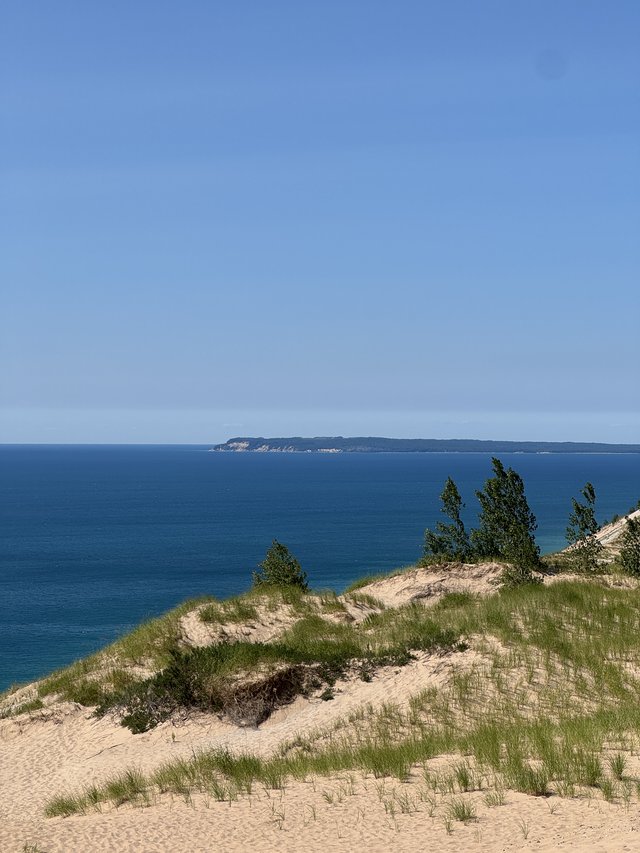
The finale, and the quietest of the big views. A little over a mile of climbing through the old Port Oneida farm district brings you to a bluff where the dune falls away almost vertically and the two Manitou Islands sit dead ahead on the water. Hang gliders launch from here on the right wind. It is also the place to tell the story the whole park is named for. In Anishinaabe tradition, a mother bear and her two cubs swam Lake Michigan ahead of a fire; the mother reached this shore and climbed the bluff to watch for her cubs, who tired and went under within sight of land. The Great Spirit raised two islands where the cubs drowned and a lone dune where the mother still waits. Worth knowing: the tidy version printed on placemats traces to a nineteenth-century federal agent, not to Native storytellers, and Anishinaabe people, the Odawa, Ojibwe, and Potawatomi whose homeland this is, are reclaiming the telling on their own terms. Stand at Pyramid Point, look at those two islands, and the story does not need embellishing.
Host's take
Four hundred feet of sand above the bluest water in the Midwest, and a park quiet enough that a Tuesday in September feels like it belongs to you.
Half a Day, If That's What You Have
Not everyone wants a full day on their feet, and the loop shortens cleanly. The three essentials are the Pierce Stocking drive for the overlook, the Dune Climb for the sand, and either the visitor center in Empire or Glen Haven for a sense of the place. Leave after breakfast, do those three, and you are back in Traverse City for a late lunch with the whole afternoon still ahead of you. On a hot day, trade a hike for a swim: North Bar Lake is a shallow pocket cut off from the big lake by a strip of sand, so it warms up like a bathtub while Lake Michigan stays bracing, and it is a two-minute detour off M-109. That single swap turns a scenery day into a beach day without leaving the park.
Planning a trip?
The Observatory is our loft in the Grand Traverse Commons, forty minutes from the first overlook on this loop and a short walk from dinner the night you get back.
Check Availability →The Pass, the Ferry, and the Fine Print
You need a park pass, and the park went cashless in 2023, so bring a card. Twenty-five dollars covers a vehicle for seven days and every stop on this loop; a Sleeping Bear annual pass is forty-five, and the America the Beautiful pass that covers every national park in the country is eighty and worth carrying if you travel. Buy it at the Philip A. Hart Visitor Center in Empire on the way in, at the Pierce Stocking entrance booth, or ahead of time on recreation.gov. The scenic drive itself is seasonal, roughly late May through late October, with a gate that opens at nine and closes thirty minutes after sunset, so a sunset at the Lake Michigan Overlook comes with a hard exit time.
A word on the Manitou Islands, because guests ask: the ferry from Leland is not running at all in 2026 while the Park Service rebuilds both island docks. Even in a normal year it is a full-day trip of its own, a ninety-minute crossing each way to walk an undeveloped island, not a stop you tuck into a driving loop. Save it for a return visit, and confirm the boats are actually running before you build a day around them.
Dogs come on this trip with limits. They are welcome on most trails and at Glen Haven Beach on a six-foot leash, but not on the Dune Climb, not at the Maritime Museum, and not at North Bar Lake. We bring Poppy for the bluff trails and the beach and leave the sand wall for a dog-free day. For food beyond Glen Arbor, Empire has Joe's Friendly Tavern, pouring since 1945, and Grocer's Daughter for chocolate. Most kitchens out here keep seasonal hours, so in the shoulder seasons a quick call saves a closed door.
Questions Guests Actually Ask
How far is it from Traverse City? About twenty-five miles and thirty-five to forty minutes to the visitor center in Empire, straight out M-72. The Dune Climb is five miles further, so roughly forty-five minutes door to sand.
Do I need a pass? Yes. Twenty-five dollars per vehicle for seven days, forty-five for a Sleeping Bear annual, eighty for the all-parks America the Beautiful pass. Cashless since 2023. Buy it at the visitor center, the Pierce Stocking booth, or on recreation.gov.
Is the Dune Climb hard? The first hill is a sweaty twenty minutes and worth it. The full crossing to Lake Michigan is three and a half miles round trip and punishing on the way back, so skip that on a loop day.
Can I take the ferry to the Manitou Islands? Not in 2026, the docks are closed for reconstruction. In a normal year it runs from Leland, May through October, and it is a full day on its own, not a loop stop.
When should I go? Late September into mid-October is the best of it, warm enough with fall color and thin crowds. In summer, go early or late and go midweek; weekend lots fill by mid-morning.
Where do I eat? Glen Arbor is the middle of the loop: Art's Tavern and Cherry Republic. Empire has Joe's Friendly Tavern. Check hours in the shoulder seasons.
Can I do this and a wine day? Not well in the same day, they pull in different directions. But a Sleeping Bear day pairs naturally with a slower morning in Leland or a wine afternoon the day before. Our Leelanau wine loop guide covers that side of the county the same way we cover this one.